Groups and special prices
A percentage or amount for a customer group, a special price, and a rounding method on every rule.
Discounts, bonuses, statuses, gifts and customer messages run inside your ERP system. No separate server and no data export to a CRM.
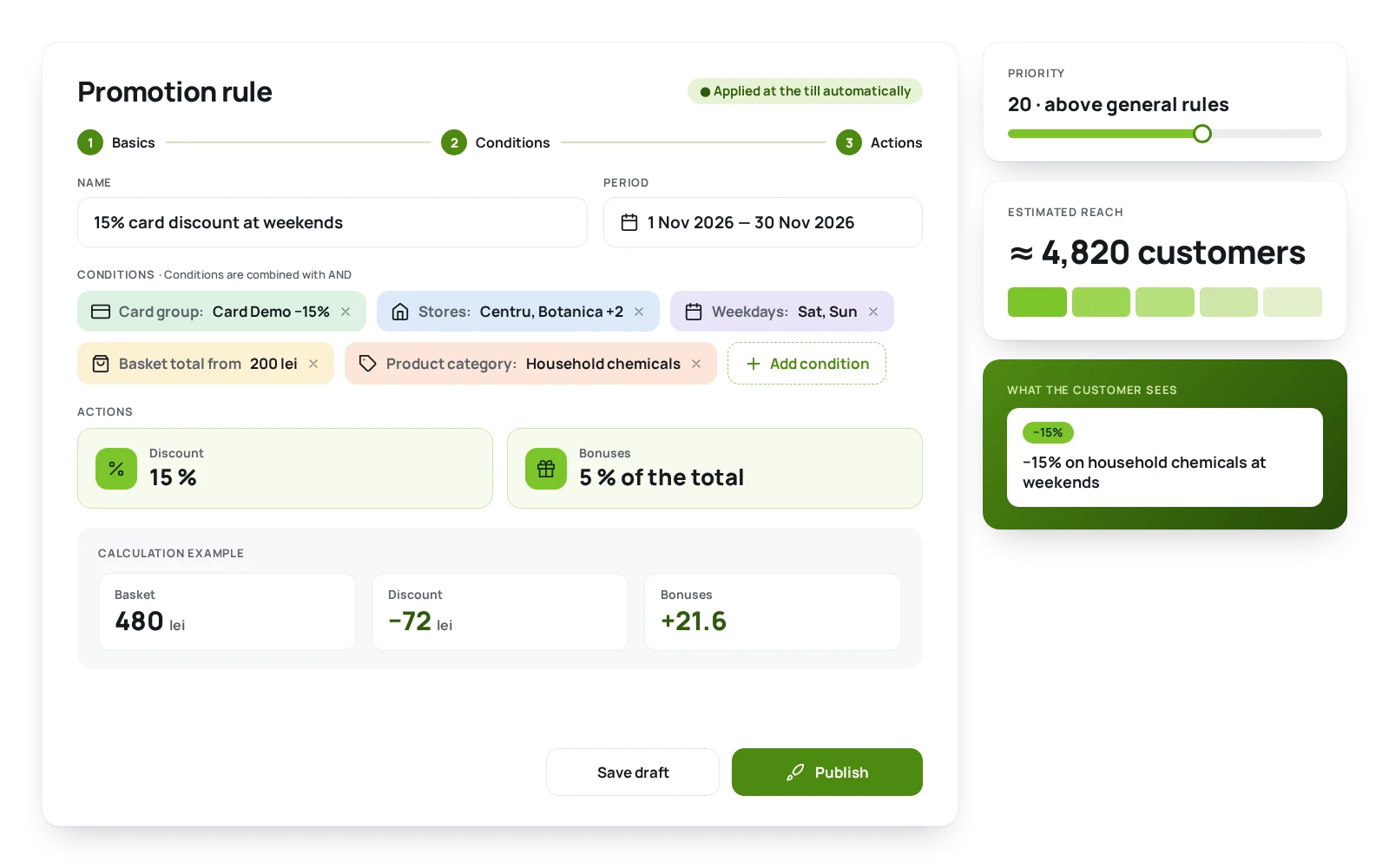
The loyalty module in your ERP brings discounts, bonuses that expire, customer statuses, gifts and messages, all set up as rules inside the accounting system where your customers and receipts already live. A rule is defined by data, not code, so the marketer changes the terms of an offer without a programmer.
Every rule is built from four parts. The same approach describes a receipt, opening an account, a birthday and a change of customer segment.
What starts the rule: a posted receipt, a birthday, a segment change and more. There are 12 event types.
Chain, store, weekday and time, receipt total, products, customer group, status, segment. There are 25 condition types.
Discount, bonuses, gift, status change, account operation. There are 13 action types.
A short text for the cashier or the customer at the right moment.
A percentage or amount for a customer group, a special price, and a rounding method on every rule.
The more items or the larger the amount, the higher the percentage. A quantity discount can carry a price filter.
Every Nth item discounted or free, the N+M scheme.
A set at a fixed price. It applies only when it beats the discounts already calculated, and the bundle price is protected from rounding.
A discount when two given products are on the same receipt.
Validity dates, weekdays and hours. A rule fires only if it is posted and falls within its period.
Accrual from the receipt total or per line, a multiplier for every Nth visit. Bonus lifetime is set in the rule, and expired bonuses are written off on a schedule.
A customer moves to a new level by the amount spent over a chosen period. The history of status changes is kept.
A gift with a purchase, a gift for answering a questionnaire, a customer declining a gift.
Gift certificates with a face value, expiry date and PIN, coupon generation, checking and redemption at the till. These are features of the ERP module.
An accumulation card: "N purchases, one prize". Also in the ERP module.
Four account types: financial, goods, bonus, corporate. The bonus rate and account movements live in one place.
A lifecycle segment can be used as a condition in any rule, and a segment change is an event. A reactivation campaign is built without a programmer: a segment condition, the event, a message. On this event you can send messages, change a status and award bonuses. More on the lifecycle page.
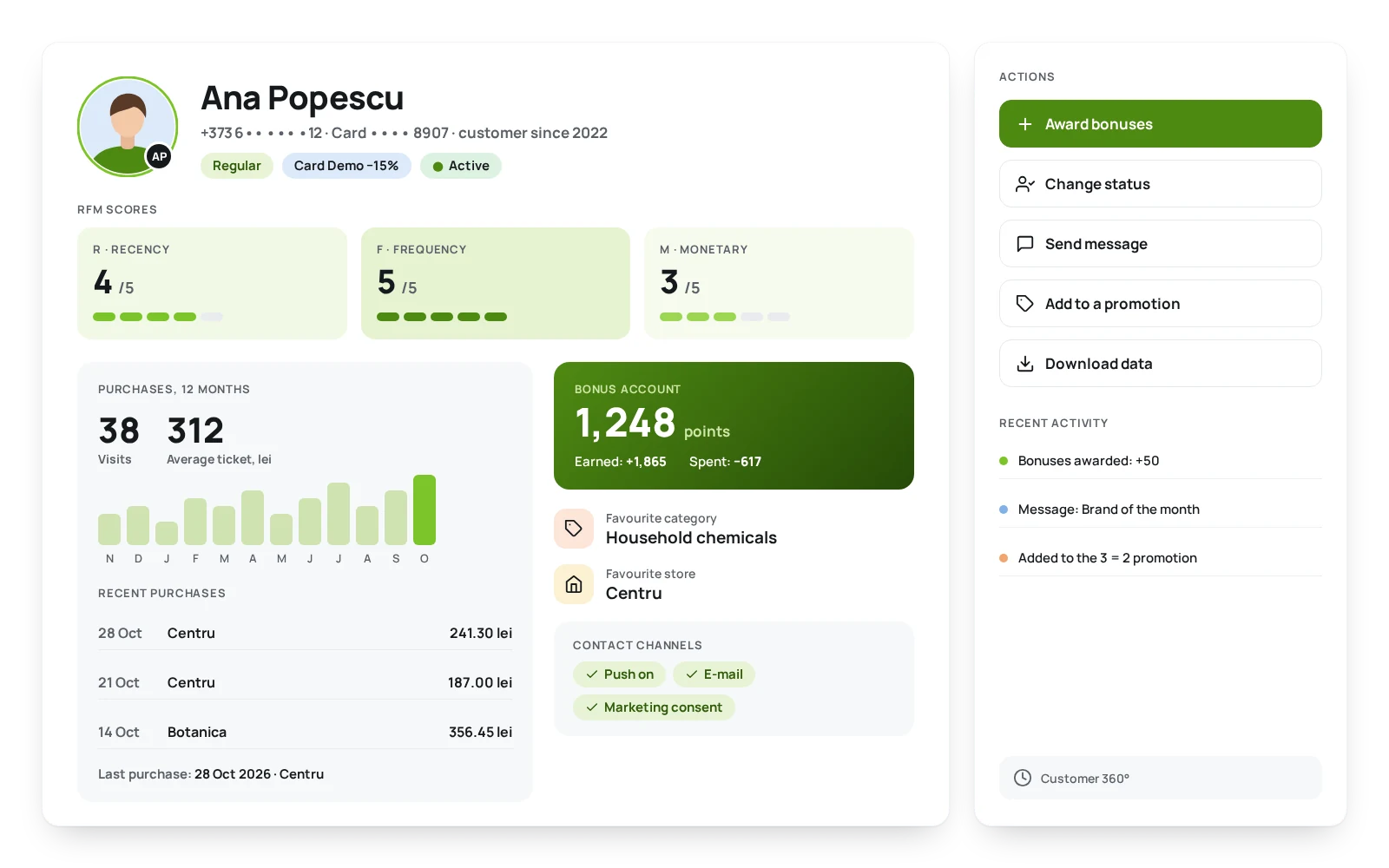
A control group is built into the rule: some customers do not receive the offer, and the difference shows its real effect. A customer always stays in the same group.
Reports cover discounts granted, bonus turnover, customer and discount rankings, certificates, birthdays, questionnaires and ratings, plus the 12 lifecycle reports.
The ERP module is a good start for a chain with a single accounting system. As stores multiply, it is easier to manage rules and bonuses in the web center: customers, cards, groups and rules move there without losing history, and the calculation can be checked against the previous one. Certificates, coupons and stamp cards stay features of the ERP module.
No. The module runs inside your ERP system, next to the customers and receipts.
Yes. A rule is described by data: event, conditions, actions and messages. A programmer is needed only for non-standard cases.
Yes. The ERP module has gift certificates, coupons and stamp cards. The web center does not support them yet.
Customers, cards, groups and rules are moved by a dedicated loader. The calculation can be compared with the previous one before launch.
A 30-minute conversation about your loyalty program, with no generic slides.