Industries

A loyalty program for different kinds of stores

Which mechanics suit grocery and non-food retail, pharmacies, fashion and multi-format chains, and which task they usually solve.

A retail loyalty program depends on how often and for how much people buy. A grocery store, a pharmacy and a clothing shop need different rules, so mechanics are assembled from the same building blocks. Below is what suits each format. We promise no effect figures: they depend on your customer base.

Which stores

Grocery retail

Mechanics: card-group discounts, expiring bonuses, quantity tiers, "buy N, get M", conditions by weekday and hour, till messages. Task: keep frequent shoppers without discounting those who are loyal anyway. Example: bonuses on the second purchase of the week and an expiry reminder.

Non-food retail

Appliances, home goods. Mechanics: bundles and product pairs, gift with purchase, special prices, status by turnover. Task: purchases are rare but large, so the customer must be brought back on time. Churn is judged by the customer's own rhythm. Example: an accessory offered at a bundle price with a device.

Pharmacies and cosmetics

Mechanics: bonuses on selected product groups, a ban on discounts for chosen groups, a birthday window, till messages. Task: steady customers with a regular basket. Restrictions by product group are set by a rule. Example: bonuses on cosmetics, none on the chosen groups.

Clothing and footwear

Mechanics: offers with a banner and products, tiers ("second pair"), birthday, status, mailings. Task: seasonal sales and bringing shoppers back afterwards. Example: a second pair of shoes cheaper and a banner for the new collection.

Multi-format chains

Mechanics: conditions by chain, point and division, one card for all formats, a control group. Task: one customer and different offers per format. Example: one card in the supermarket and in the neighborhood store, with different offers.
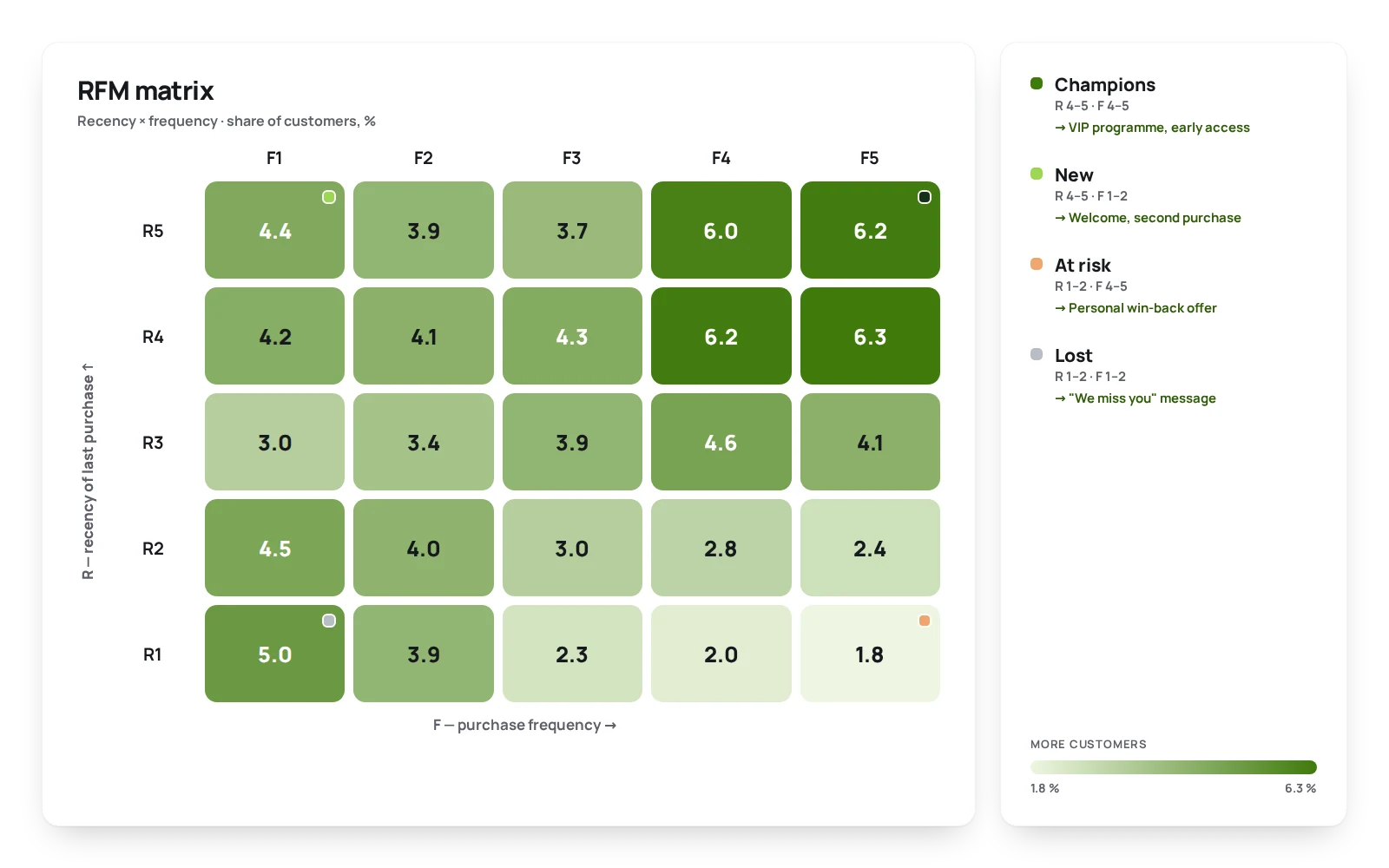
Customer segments by RFM
Segments show who should get which mechanic

Where to start

  1. Look at purchase frequency

    Daily purchases call for bonuses and reminders, rare ones for bundles and timely win-back.

  2. Pick one or two mechanics

    For example a card-group discount and expiring bonuses. The rest can be added later.

  3. Check it on one point

    A pilot shows how the rules work on your receipts before the whole chain launches.

What they all share

  • The marketer builds the rules, without a programmer
  • A card in the phone and on plastic
  • Three calculation modes and selling without a connection
  • Lifecycle analytics: you see who is leaving

Cafés and restaurants (HoReCa) are not offered as a separate solution. If you also have a retail part, tell us your task at the demo.

Frequently asked questions

Can I set different rules for different stores?

Yes. Rules are bound to a chain, point or division, while the customer is the same everywhere.

Is it suitable for a small store?

Yes, you can start with one point and one mechanic. The rest is added later.

Are there industry templates?

Rules are configured for your assortment. We show examples of mechanics for your format at the demo.

See the solution on your own network

A 30-minute conversation about your loyalty program, with no generic slides.