Many complex mechanics
Coupons, certificates, punch cards and extended rules are needed in your program right now.
A loyalty module inside the ERP or a web center: how they differ, when each fits, how to switch without losing history and when to use both.
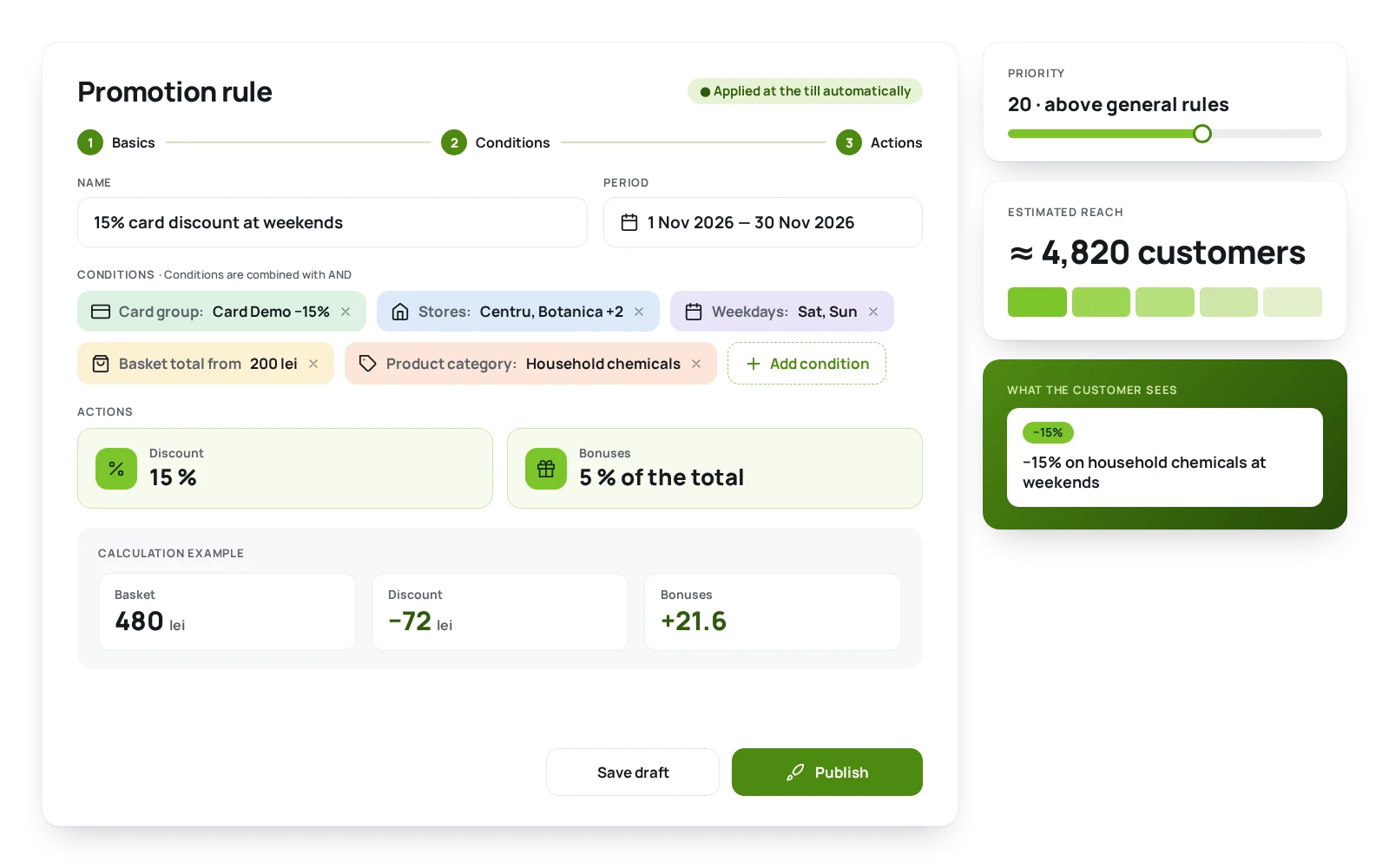
A chain has to decide where discount rules and bonuses live. One option is loyalty in the ERP, as part of the accounting system. The other is a separate web loyalty system that serves the tills of all stores. The choice affects how fast changes arrive, how the store works without a connection and the cost of ownership, so it pays to compare both before you choose a loyalty platform, not after.
Both are part of Synngate Loyalty, so the comparison below is not about "better" or "worse": it is about what fits your chain today.
| Question | ERP module | Web center |
|---|---|---|
| Where it runs | Inside your ERP system | A separate web service, in the cloud or on your server |
| Infrastructure | No separate server | A service and its hosting are needed |
| Rules | 25 kinds of conditions, 13 kinds of actions, 12 event types | 17 conditions, 11 actions |
| Coupons, certificates, punch cards | Available in the ERP module | Not supported yet |
| Lifecycle analytics | 12 segments, 12 reports, 60 indicators | Segments and 5 reports, including promotion effect |
| Link to the till | A web service for exchange with the till | A till API: identification, calculation, confirmation |
| Working without a connection | The till does not block a sale if the server is unavailable | Three modes: center, store node, core inside the till |
| Where rules are changed | In the familiar ERP interface | In the web interface; changes reach the store within seconds |
The table reflects what is possible today: verify the current state at a demo.
Coupons, certificates, punch cards and extended rules are needed in your program right now.
Stock, prices and customers in one place, and you do not want extra infrastructure.
You need lifecycle segments and detailed reports about the customer base.
Rules change often and a change must reach all stores quickly.
The store must not depend on the link: the calculation runs on the store node or inside the till.
The card in the phone, offers and the marketer's workspace are easier to build around a separate center.
If you hesitate, ask yourself: what hurts more, speed and reliability at the till, or the depth of mechanics and analytics? The answer shows where to start.
First write down your own conditions and only then look at products. Otherwise the brightest features will decide, not your needs.
Compare not the license price but all the cost items over several years. For the ERP module these are customizations and updates inside the accounting system and programmers' time. For the web center: hosting the service, administration and integration with tills. In both cases there are costs for training, data transfer and support. Ask the vendor for a list of what is included in the work and what is paid separately, and compare the lists.
The choice is not for life. Many chains start in the ERP and move to the web center later, when the number of stores grows. What is moved: customers, cards, groups and rules. The web center's calculation can be checked against the previous one on a set of real receipts, and the differences are reviewed before going live.
Decide which rules stay and clean up duplicate customers.
Load a copy of the data, compare the number of customers, cards and the bonus total.
Recalculate a set of real receipts in the new system.
One or two stores run on the new system, the rest on the old one.
The other stores move, and the previous module stays read-only.
An important limit: coupons, certificates and punch cards are not moved to the web center yet; they stay in the ERP module. If you need them, use both solutions together.
Sometimes some mechanics need the ERP, while the tills need the speed and autonomy of the center. Then the chain runs on the web center, and the specific mechanics stay in the ERP module. This is an intermediate stage, not a permanent answer: treat it honestly, with a plan for what moves and when.
A practical tip: before deciding for the whole chain, run a pilot in one or two stores. A pilot shows what a presentation does not: how cashiers react to the new flow, how clear the admin is for the marketer, which differences appear when receipts are compared. Agree success criteria and a deadline for the pilot in advance, otherwise it will drag on without a decision.
In Synngate Loyalty you can start with any part. Details are on the pages of the ERP module and the web center; what the move looks like is explained in the article on moving from plastic cards, and analytics is described on the lifecycle page. To choose the option for your chain, request a demo.
Yes. Customers, cards, groups and rules are moved, and the calculation is checked against the previous one. It is the standard path.
Coupons, certificates and punch cards stay in the ERP module. If you need them, use both solutions in parallel.
It runs as a web service: in our cloud or on your server.
No. We have our own till with loyalty built in, and an open API is provided for other tills.
A discount and a bonus look alike, but they affect margin, purchase frequency and the cashier's work differently. We compare them on one receipt and give a rule for choosing.
Read more →A step-by-step launch plan: from the goal and mechanics to cashier training and first measurements. No promised timelines: they depend on your chain.
Read more →R, F and M explained with a store example: how scores are calculated, who sits in the corners of the matrix and what to do with each group. The method is simple, but it has limits.
Read more →A 30-minute conversation about your loyalty program, with no generic slides.